
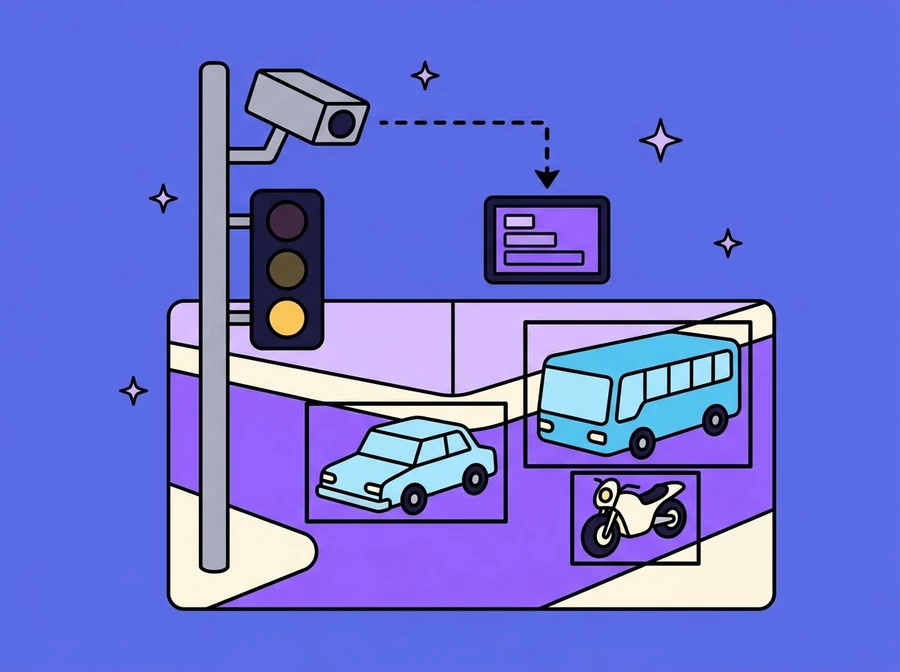
Most CCTV is used as evidence after the fact rather than as a source of data feeding real-time decisions, even though the footage is being recorded every second anyway. This system uses Deep Learning to read images from cameras on live roads, classify density into levels, and pass the result straight on to a person or a downstream system. ThinkVerse AI built it as an image-analysis system for adjusting traffic signals to the actual volume of vehicles.
Built for
City authorities and organisations that already have CCTV installed but still use it to look back rather than to decide
Starting from the cameras already installed
The work starts with collecting data, not with installing new cameras. The system pulls images from CCTV on live roads through a government Open API, then processes them into a dataset covering every level of traffic, from clear roads to heavy congestion. The important point is that the dataset has to contain both extremes rather than only the stretches that look interesting, because a model that has never seen normal conditions cannot pick out the abnormal ones.
- Images pulled from live CCTV through a government Open API
- Images processed into a dataset for training the model
- Dataset covering every level of traffic
Training the model to tell density levels apart
The next step was training a Deep Learning model to classify traffic density into three levels: clear, moderate and congested. Within the same image the system also detects individual objects (cars, buses, motorcycles and pedestrians), each with a confidence score attached, so a result can be traced back to what the model saw before it decided, rather than simply returning an answer.
- Density classified into three levels
- Individual objects detected with confidence scores
- Covers cars, buses, motorcycles and pedestrians
- Results can be traced back
Passing the result on to be used
An analysis is worth nothing if no one receives it. The system therefore sends its real-time results on in two directions. The first is an alert to a person via LINE Notify, for cases where a human has to decide. The second goes into the signal-control system, to extend or shorten light phases to match the traffic actually on the road rather than running only to a pre-set timetable. The same structure extends to other work that uses cameras as sensors, which is the route most Smart City projects take.
- Alerts to operators via LINE Notify
- Results fed to the signal-control system to adjust timing automatically
- Runs continuously in real time
- Extends to other work using cameras as sensors