
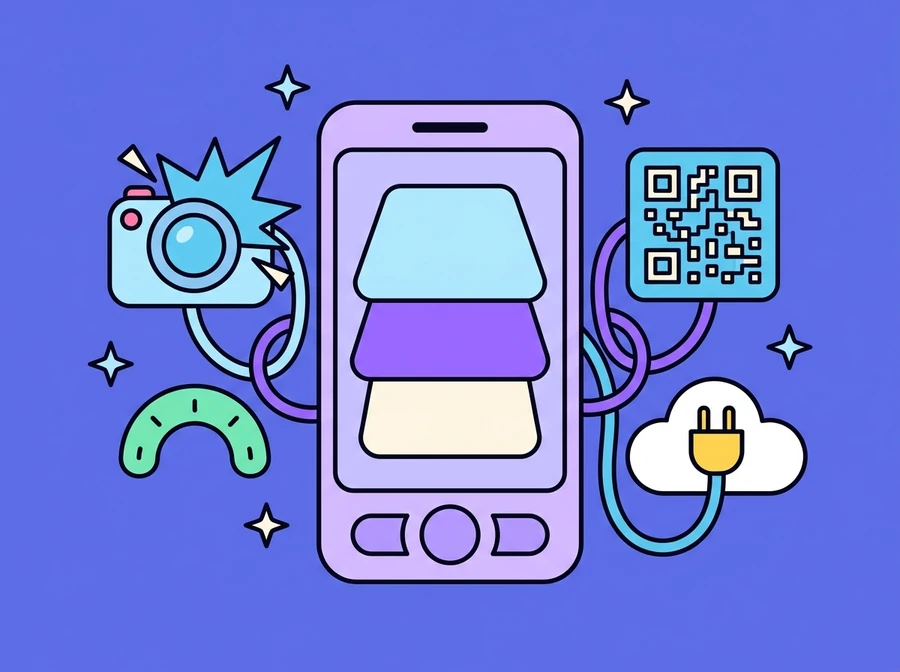
We build mobile applications for both consumer and corporate use: screen design, user accounts, integration with back-end systems and payments, and testing on real devices. Past work covers an app that analyses meals from a photograph, a Thai auspicious-date calendar app, a guitar effects app where audio latency had to be kept under control, and a booking app with both a customer side and a provider side. Every one of them is designed to be genuinely usable on a small screen with one hand.
Who it is for
Businesses that want their own app for end customers, and organisations that need an app for staff or partners working away from the office.
Designed to work on a small screen
A phone screen has no room for everything, so we start by asking when people open the app and what they need to see in the first two seconds. The home screen in the apps we build is therefore a summary of today set against the user's own goal, with a small handful of shortcuts for the things done most often; everything else sits one menu further in. Thai and English can be switched within the same app.
- A home screen summarising what has to be seen first, with shortcuts for frequent tasks
- Designed to be operated with one hand
- Thai and English switchable within one app
AI in the app, working with what the user already has to hand
The camera, the microphone and the user's own data make the phone the place where AI makes the clearest difference. Work we have already done includes analysing Thai dishes from a photograph, returning the name of the dish, its energy content, its nutrient breakdown and a confidence score for the analysis, so the user knows when to check the result again before saving it, and real-time audio processing with AI amplifier modelling. In-app content can also adapt to each user's profile.
- Image analysis from the device camera, with the confidence level shown
- Audio processing and other work that needs low latency
- Content and recommendations tailored to the user's profile
Connected to the back office, bookings and payments
Most apps do not end at the app itself: there has to be a back office where your team looks after the data, and there is usually more than one group of users. We build the whole loop (user accounts and sign-in, a booking system where users choose their own time slot, PromptPay QR payment, status tracking after payment, and management screens for the provider side and for administrators), and we connect it to the web platform so both sides work from the same data.
- User accounts and sign-in, including sign-in with Google
- Booking and job status tracking
- PromptPay QR payment
- Management screens for administrators and for partners
- Works from the same data as the web platform
Tested on real devices, and looked after beyond the first release
No two users' devices are alike, so we test on real handsets before release. And where latency has a direct effect on use, as with the guitar effects app, we include a device test mode that measures latency and noise level so users can check for themselves before playing, with automatic fallback when the device cannot keep up. After the first release we keep improving in cycles, based on what real use shows us.
- Tested on several real device models before release
- A device check mode for work where latency has to be controlled
- Continued improvement in cycles after launch
What it does
- Screens designed to be used one-handed
- Home screen summarising the key information, with shortcuts
- AI camera image analysis with a confidence level
- Support for audio work and low-latency features
- User accounts, booking and status tracking
- PromptPay QR payment in the app
- Thai and English switchable within one app
- Real-device testing and support after the first release

Want something like this?
Tell us your situation and we will work out what needs adapting to fit it.