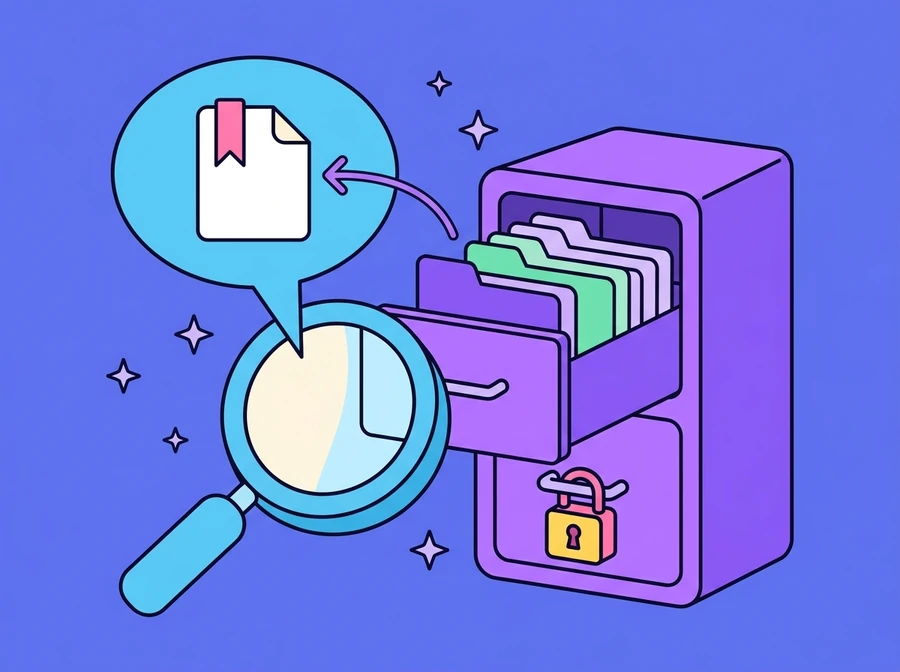
A question-and-answer system that draws its answers from the organisation's own documents: policies, manuals, contracts, past project files and support history. It searches on the meaning of the question rather than on matching words, and every answer points back to the document it came from, so the reader can open it and check. The approach behind it is retrieval-augmented generation (RAG), and it runs through LINE OA, Web Chat and internal systems.
Who it is for
Organisations whose knowledge is spread across a large body of documents, and who have to answer questions that always need backing up: compliance, contracts and procurement, HR, or a support team fielding the same questions every day.
Most of the work is in the documents, not in the model
Before anyone can ask a single question, the documents have to go through several steps. They are collected from wherever they actually live: shared drives, email attachments, the old document system, and scans that are still only images. Then they are cleaned, which means OCR for the scans, stripping the headers and footers that repeat on every page, and taking superseded versions off the pile.
Next each document is cut into chunks, short enough to retrieve but complete enough to stand on their own, each one still carrying its document title and heading, because a chunk cut in the wrong place drops the condition that made the answer correct. Every chunk is then turned into a vector (an embedding) and stored in an index that can be searched by meaning. The last step is keeping it current: a policy revised last month, read against an index built last year, gives the wrong answer in exactly the same confident tone. The re-indexing cycle, and the way superseded documents are retired, are designed in from the start.
- Collects documents from shared drives, email and existing document systems
- OCR for scanned files, with repeated page furniture stripped out
- Chunks that stand on their own, tagged with document title and heading
- Embeddings that make the material searchable by meaning
- A re-indexing cycle, and a way to retire superseded versions
An answer nobody can check is not an answer you can use
Every answer comes back with its source attached: the document name, the version and date, the page or section the passage was taken from, and a link that opens the original. In work with rules around it, compliance, contracts, or anything that becomes a commitment to a customer, what the user has to pass on is not the summary. It is the passage in the document, and where to find it.
Citation does a second job as well: it is how a wrong retrieval gets caught. If the system reaches for the wrong version or the wrong context, the reader sees it in the source rather than having to take the answer on trust. And when retrieval turns up nothing relevant enough, we design the system to say exactly that and pass the question to a person, instead of filling the gap with something that merely sounds reasonable.
- Cites the document, version, date and the page or section used
- A link in the answer opens the original to read on
- A wrong version or wrong context is visible straight away
- When nothing relevant is found, it says so and hands over to a person
Not everyone should be able to retrieve every document
Access rights have to work at retrieval, not at the answer. The system narrows the candidate documents by the identity and role of the person asking, and only then passes what that person is allowed to see to the model, because anything the model reads can end up in the reply, and hiding it afterwards is not a control.
Wherever we can, those rights are inherited from the systems the organisation already runs, at folder, department or project level, so there is no second permissions table to keep in step with the first. Every question, and every document returned for it, is logged, so a data owner can review what was asked and what was seen. This is the same ground as PDPA and data governance, and it belongs in the design from day one rather than arriving afterwards.
- Rights applied at retrieval, before any content reaches the model
- Permissions inherited from existing document systems, not duplicated
- Knowledge separated by department, project or confidentiality level
- Questions and the documents used are logged for later review
In the channels people already use
Nobody should have to open a new tool to ask one question, so the assistant connects to LINE OA for people asking from a phone with the work in front of them, and to Web Chat embedded in a website or the company intranet, with a link into internal systems where that is needed. Every channel draws on the same knowledge base and the same permission rules.
A chat channel has no login of its own, so a LINE account is linked to an employee account before use, and the same rights apply wherever the question arrives from. Citations travel as links that open the source document from inside the chat, and a question the assistant cannot answer is handed to a member of staff in the same conversation, so the person asking does not have to explain everything again from the beginning.
- Available through LINE OA and Web Chat on a website or intranet
- LINE accounts linked to employee accounts, so rights hold on every channel
- Source documents open from a link inside the chat
- Unanswered questions pass to a member of staff in the same conversation
What it does
- Answers from your own documents, not the model's general knowledge
- Searches on the meaning of the question, not on matching words
- Every answer carries its source: document, page and a link to the original
- Access rights applied at retrieval, before anything reaches the model
- Full document preparation, from OCR and chunking through to embeddings
- A re-indexing cycle that keeps answers on the current version
- Available through LINE OA, Web Chat and internal systems
Want something like this?
Tell us your situation and we will work out what needs adapting to fit it.